

NEW YORK — The students already had an idea for their song before the instructions were finished.
They wanted to write something for Mr. Greene, the teacher who had shown up for them when it counted. And now, sitting in front of a laptop at A. Philip Randolph Campus High School on a frigid Thursday morning, they had a tool that could actually help them do it. The students typed a description into Suno, an AI music generator, hit create, and thirty seconds later heard a real song come back, with a melody and a voice, about a teacher they admire. When Mr. Greene heard it, he was seen wiping his eyes.
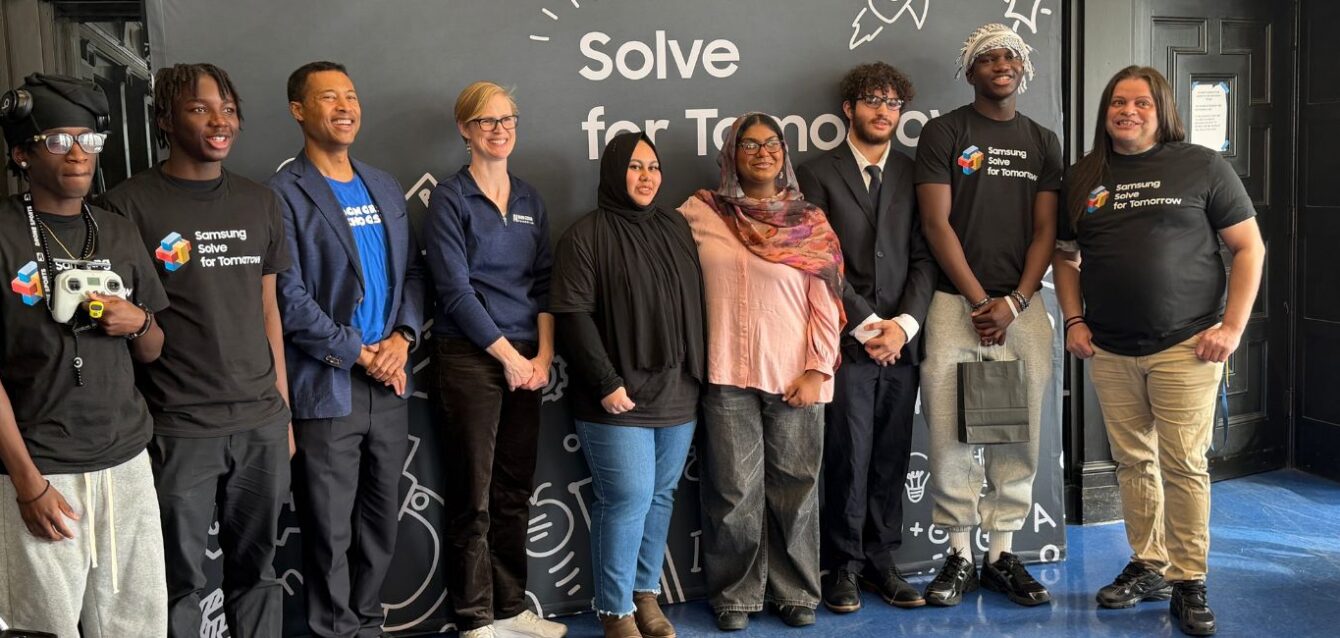
The Samsung AI in Action Lab, a first-of-its-kind event produced by Samsung Electronics America alongside the Mark Cuban Foundation, brought 67 students face-to-face with some of the most recognized names in American entrepreneurship. Mark Cuban, investor and minority owner of the Dallas Mavericks, was there. So was Emma Grede, the fashion entrepreneur and co-founder of SKIMS. Charlotte Dungan, the Mark Cuban Foundation’s Chief Learning Officer, spent the morning with the students, watching, redirecting, and pushing them when they got stuck.
That iterative process, Dungan noted, is part of the point. The school, she said, was eager. But the gap between enthusiasm and preparation was real. Students had spirit. What they lacked was access.
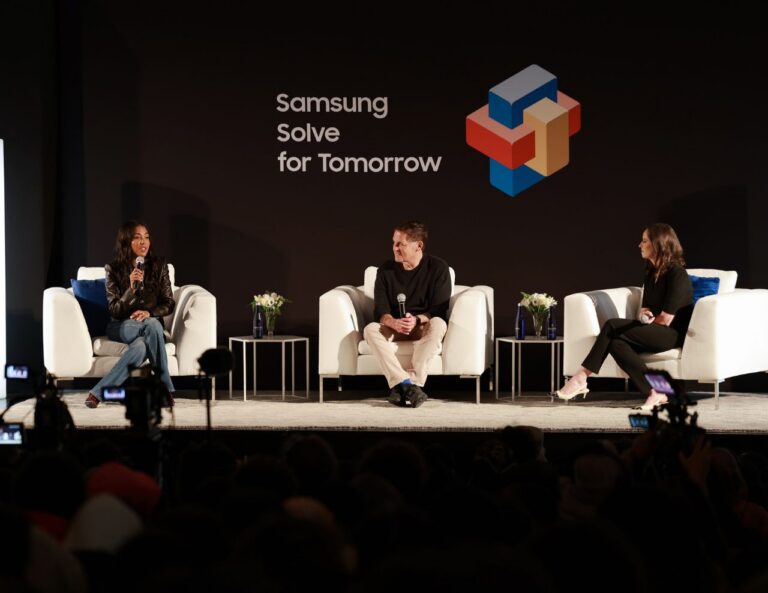
Emma Grede, left, with Mark Cuban and Allison Stransky, Chief Marketing Officer of Samsung Electronics America. (Getty Images for Samsung Electronics)
That gap is exactly what Samsung’s Solve for Tomorrow initiative has spent sixteen years trying to close. Now in its second decade, the program has invested more than $29 million in technology and resources across American public schools, reaching nearly three million students globally. The AI in Action Lab extends that work into what Samsung is calling an “AI for All” era, a bet that access to artificial intelligence, like access to the internet before it, will shape which communities get ahead and which ones don’t.
The stakes are not abstract. While 88 percent of teachers recognize AI as critical to their students’ future careers, more than half say they have received no formal training in it themselves. As digital natives, the students in that auditorium were, in many ways, ahead of the adults responsible for teaching them.
The morning opened with a fireside panel. Cuban and Grede joined Allison Stransky, Chief Marketing Officer of Samsung Electronics America, to speak with students about risk, technology, and the particular challenge of being young in a world that keeps changing faster than textbooks can track.
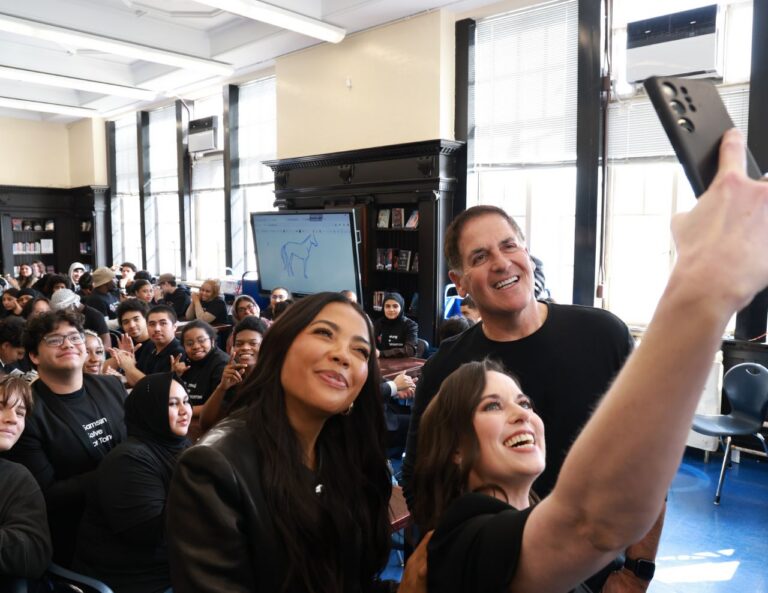
From left, Emma Grede, Allison Stransky, and Mark Cuban pose for a selfie with students. (Getty Images for Samsung Electronics)
Cuban kept his message direct. Onstage before a room full of teenagers who grew up watching him on television and in memes, he told them to stop waiting for permission. Think about whatever idea was sitting in the back of your mind, he said. Then ask yourself one question.
“Why not me?” he told them. “Why can’t I be the person to take this idea I have and turn it into something special? Because among everybody here, at least one, if not many more, could have a world-changing idea. There’s nothing that can stop you from changing the world.”
After the panel, Dungan took over. The students ran through two hands-on activities built specifically for the session. In the first, they used Suno to compose original songs, the only requirement being an idea. In the second, they trained AI models to recognize athletic poses using Google’s Teachable Machine, recording each other mimicking good form in basketball and baseball, then watching the system learn, misfire, and slowly get it right.
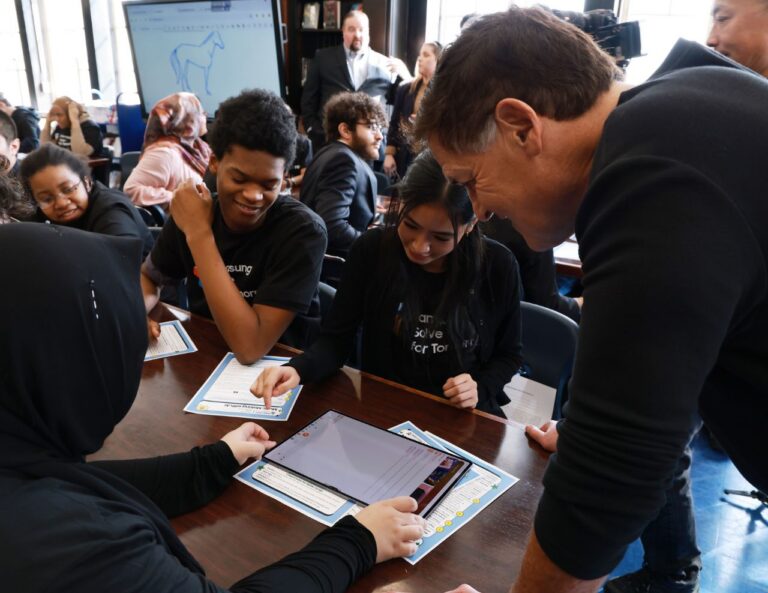
Mark Cuban speaks with students gathered around a tablet while discussing their project during the AI in Action Lab. (Getty Images for Samsung Electronics)
While one group trained AI to see them, another had asked AI to speak for them. They typed a name into a music generator and seconds later heard something come back that captured, somehow, exactly what they meant, a full song, with a melody and a voice, built for a teacher who had no idea it was coming.
By the end of the event, these students had built something, trained something, and heard their own ideas played back to them in ways they hadn’t expected. Cuban’s question from the stage was still hanging in the air. They had spent their morning beginning to answer it.