


Go Beyond Basic AI Literacy
The Mark Cuban Foundation offers free AI education programs for high school students, teachers, and adults at community colleges. Since 2019, over half a million students have learned about AI and ethical innovation through our initiatives. Every program is free to attend.
What AI literacy means, and why we go deeper
Most training programs call the first step “AI literacy,” which means learning basic AI skills and ethics. Learners find out what AI is and how to cite it correctly. A 2025 report from the Computer Science Teachers Association and AI4K12 found that “eight out of ten CS teachers believe that learning about and using AI should be part of a foundational CS learning experience.” We agree, so every Mark Cuban Foundation program starts with these basics.
How AI skill builds, stage by stage
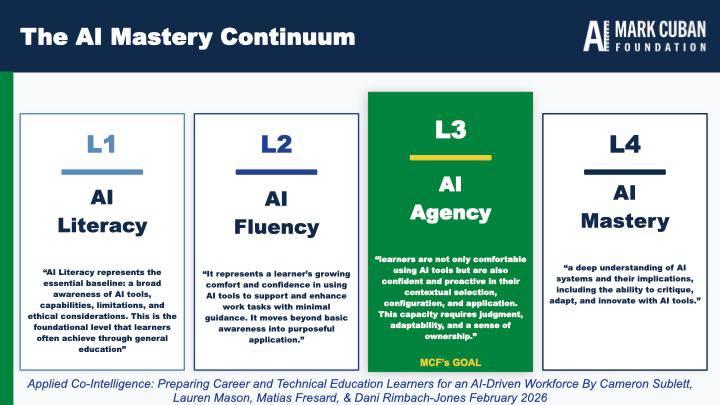
Based on the Applied Co-Intelligence: Preparing Career and Technical Education Learners for an AI Driven Workforce report, we develop AI skills over time:
- AI Literacy is referred to as “the essential baseline” in the report. Teachers explain the AI policy for each assignment and give clear citation rules. This way, students know when they can use AI in class and how to cite it.
- AI Fluency means moving “beyond basic awareness into purposeful application.” Students use several AI tools and check the results using lateral reading. Teacher Fellows include at least four AI tools in their lessons so students can see how each tool works for different tasks.
- AI Agency is our main goal. Learners become “confident and proactive” in choosing and using AI tools. Students select tools on their own to meet project goals and take charge of their learning. Teachers review the work to ensure AI use is clear and ask questions to check that each student understands their own work.
- AI Mastery is described in the report as “a deep understanding of AI systems and their implications,” including the ability to critique and adapt them. Teacher Fellows aim for this stage as they bring AI into their own classrooms.
At the Mark Cuban Foundation, students work toward AI Agency. At this stage, they choose and use AI tools as needed for their projects. They cite their sources, take responsibility for their learning, and can explain both their tool choices and ethical decisions.
Teachers help students reach this point step by step. Every assignment includes a clear AI policy and citation rules, so students know what to expect. Lessons introduce challenging problems that require careful use of AI. As students improve, projects become more complex, and students can explain each design choice. Teacher Fellows review their work with peers, checking for clear use of AI and genuine understanding.
How we teach
Our main programs usually offer 20 or more hours of instruction, giving students time to build their own AI projects. This approach is based on Seymour Papert’s constructionist pedagogy, which says people learn best by creating things that relate to their own lives.
We ensure that 80% of each lesson is active learning. In each hour, instructors talk for 12 minutes or less, while students spend most of the time on hands-on activities and discussions with peers and mentors.
Lessons follow a low-floor, high-ceiling design. Beginners can start with simple conceptual games and activities before moving to applications, while more advanced students can master the same concepts with industry-standard methods and tools. We also provide accommodations for students with disabilities so everyone can participate fully.
During AI Bootcamp, students get time over lunch with industry mentors to talk about office culture and the move from school to a career.
My favorite part of the AI experience was actually using the AI and learning how to use it in the future.
Samuel R., AI Bootcamp Student
Frequently Asked Questions
AI literacy is the first stage of AI learning, built on basic awareness and ethical understanding. A student at this stage can explain appropriate AI use, how to cite it and apply AI tools ethically to assignments. The Applied Co-Intelligence report calls it “the essential baseline.” It is the first of four stages in the Mark Cuban Foundation’s model, followed by AI Fluency, AI Agency and AI Mastery.
AI Fluency comes next, when AI is applied in assignments and tasks. Students skillfully prompt across several AI tools and verify outputs using strategies such as lateral reading. Then comes AI Agency, where students choose their own tools and strategies. They select and use AI tools at their discretion to meet project requirements, and they take responsibility for their own learning outcomes. AI Mastery, the fourth stage, is a deep understanding of AI systems and their implications.
Yes. The student AI Bootcamp, the Teacher Bootcamp, Teacher Fellows, curricular resources, and the Agentic AI Academy are all free for learners.
No. Coding experience isn’t required for any Mark Cuban Foundation program. High school students can join the AI Bootcamp with no background in computer science, though a technical track is available for those who want one. The Teacher Bootcamp is open to high school educators in any subject, including math, English and special education. Adult learners in the Agentic AI Academy build practical AI skills during the week without writing a line of code.
High school students in grades 9-12 who live in the United States can apply. The Mark Cuban Foundation actively recruits girls, students of color, students from low- to moderate-income households, and students likely to be the first in their families to attend college. In 2025, 77% of participants met at least one of those criteria.
The Mark Cuban Foundation Teacher Fellowship is a year-long, paid professional development program for high school teachers in any subject. Fellows meet virtually twice a month with a national cohort of educators, and in November, they lead AI Bootcamp sessions with high school students. Each fellow receives a stipend. The year ends with a chance to present their work at a national conference.
The Fellowship is selective. The Mark Cuban Foundation chooses fewer than 10% of applicants and invites the rest to a Teacher Bootcamp. Fellows teach in schools where at least 40% of students are low-income. Applications open each spring, and the fellowship runs the full school year, from June through May.
Stay connected
Applications are not always open, so the best way to find out about the next Fellowship or Teacher Bootcamp is to sign up for our newsletter. You can also follow the Mark Cuban Foundation on LinkedIn, Instagram, and Facebook.